Oregon Art Beat
Hidden Arts
Season 25 Episode 4 | 29m 50sVideo has Closed Captions
A secret warehouse holds nearly 20,000 artworks. A couple restores a century-old theater.
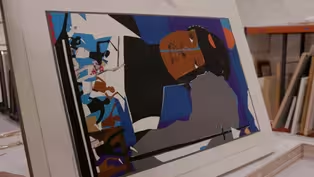
There’s a secret warehouse in NW Portland with nearly 20,000 pieces of art. It includes world class work by renowned artists like Helen Frankenthaler and Andy Warhol. The art is lent to museums regularly without a rental fee. It's all part of the Jordan Schnitzer Family Foundation collection. In Enterprise, a couple is restoring the OK Theatre - a century-old performing arts venue in their town.
Problems playing video? | Closed Captioning Feedback
Problems playing video? | Closed Captioning Feedback
Oregon Art Beat is a local public television program presented by OPB
Oregon Art Beat
Hidden Arts
Season 25 Episode 4 | 29m 50sVideo has Closed Captions
There’s a secret warehouse in NW Portland with nearly 20,000 pieces of art. It includes world class work by renowned artists like Helen Frankenthaler and Andy Warhol. The art is lent to museums regularly without a rental fee. It's all part of the Jordan Schnitzer Family Foundation collection. In Enterprise, a couple is restoring the OK Theatre - a century-old performing arts venue in their town.
Problems playing video? | Closed Captioning Feedback
How to Watch Oregon Art Beat
Oregon Art Beat is available to stream on pbs.org and the free PBS App, available on iPhone, Apple TV, Android TV, Android smartphones, Amazon Fire TV, Amazon Fire Tablet, Roku, Samsung Smart TV, and Vizio.
Providing Support for PBS.org
Learn Moreabout PBS online sponsorshipSupport for Oregon Art Beat is provided by... and OPB members and viewers like you.
Funding for arts and culture coverage is provided by... SLADE: At a secret warehouse in northwest Portland sits one of the region's most impressive collections of art.
[ ♪♪♪ ] Nearly 20,000 pieces of art housed in a state-of-the-art 50,000-square-foot facility.
This is the Jordan Schnitzer Family Foundation Collections.
The collection focuses on post-war prints, looking at all the key figures from that period.
The best names locally and the best names nationally: Jasper Johns, Ellsworth Kelly, Frankenthaler, Lichtenstein, Rick Bartow, Sherrie Wolf.
And you've got Picasso, you've got Martin Puryear, you've got Louise Bourgeois, you've got Robert Rauschenberg.
WOMAN: Frank Stella, Andy Warhol, all of the top artists of our day are really in the collection.
MAN: To have this world-class collection in Portland, Oregon, is a unique thing.
We have become an important stop in the study of post-war art because of the Schnitzer Collection.
But unlike most private collections of art, work from this collection is loaned out, free of charge, to museums across the country.
I have such passion for the art.
But it is so exceeded by my passion for sharing the art.
The idea that you do not have to pay a rental fee, I can't-- I can't even begin to describe the pressure that that takes off museums.
It frees all of us up to put the money into the way we're presenting the show, the programming we're doing for the show.
The foundation tours 20 full exhibitions a year, each one featuring anywhere from 25 to 200 pieces of art.
About a year ago in June of 2022, we put together an exhibition which we called "Judy Chicago, Turning Inward," and it was entirely from the works in the collection.
MALONE: It had 36 works that really pointed to a lot of her practice as a feminist artist and crossed over into many different areas of her career.
For my museum to be able to show works by Judy Chicago was perfect for an organization with a mission like ours.
The show was incredible.
GUENTHER: One of the early great successes of the foundation's traveling exhibition program was the Andy Warhol print show.
[ ♪♪♪ ] The collection has almost every print that Andy Warhol ever made.
It has traveled widely over the course of the last decade.
It is popular beyond belief because Andy Warhol was one of the most important artists in the post-war period.
He changed the look and the context of art in a way that this collection reveals in its fullness.
[ ♪♪♪ ] SCHNITZER: I was lucky.
I grew up with art around me.
My mother, Arlene Schnitzer, when I went to first grade at Ainsworth grade school, she enrolled in the Portland Art Museum art school.
[ ♪♪♪ ] Three years later, she, along with my grandmother, Helen Director, opened the Fountain Gallery of Art.
The Fountain Gallery was one of the region's first professional galleries.
It helped pave the way for a robust art scene in Portland.
I would go to the openings at the gallery every month or two, and it was a fun time for me.
So it was only natural for me to sort of follow in those footsteps.
I just became so enamored and enjoyed the incredible artists we have in the Pacific Northwest.
This is the study by Louis Bunce that I bought when I was 14.
So it all started with this.
And it says on the back "Bought on the night of June 23, 1965, the first piece of the Schnitzer Collection."
I've had this with me ever since.
[ ♪♪♪ ] MALONE: One of the unique things about the collection is that it's very broad and also very deep.
SCHNITZER: I've always found it easier to see a retrospective show, a show that shows decades of an artist's work, because I find it easier to get into their mind and see, "Oh, this is how they started, then this period and this period and this period."
MALONE: For Andy Warhol, it's not just collecting the Marilyns, which anyone would recognize.
But it's also collecting very early work from his days of being a graphic artist.
So if the Portland Art Museum called up and said, "We want to do a Lichtenstein show," I'd say, "Okay, I've got some early work from 1952 when he was just teaching and 270 works all the way through the 1997 Tel Aviv Benefit print and every period in between.
It's all framed.
When do you want it?"
Eleven full-time staff members work to catalogue, ship, maintain, and care for this collection.
The warehouse includes a wood shop for building custom shipping crates, a photo studio to document each piece of art in the collection, and multiple work stations for evaluating and maintaining the art.
I've always felt, if you're lucky enough to have the art, then you have an obligation to take care of it, because it will go on beyond your life, because these have to stay around for hundreds of years for thousands of audiences.
MALONE: Right now we're working on a David Hockney print retrospective that's being organized by the Honolulu Museum of Art.
We've been working on it for over a year.
There's 142 pieces in the exhibition, and the registrars have been looking at the work really closely to examine its condition, readiness to be displayed for the exhibition.
[ ♪♪♪ ] GUENTHER: The foundation's outreach program to students and children, it was an important innovation that Jordan brought to the table very early in the formation of the foundation.
His choice to make available the funds to open the world of art to children through his program and the exhibitions is unique among collectors and foundations.
SCHNITZER: It's not like a calculus class or a chemistry class where 1 and 1 have to equal 2.
And just maybe if we can get enough kids in to see art and let it be part of their life, they won't think, "Well, that art stuff is for some elitist few, for somebody else."
In 2004, the foundation began publishing its own books for use by museums, galleries, and researchers.
It's really an important way to create scholarship around the work of the artist and the exhibition.
But beyond that, he's published a couple of catalogue raisonnés, which is basically an encyclopedia of every print that an artist has made to date with all of the technical information and academic research around that work.
[ people chattering indistinctly ] SCHNITZER: In the last month, I've had five openings around the country.
There must be maybe five or six or seven thousand people a day that go through our exhibitions, so we've had hundreds of thousands of people a year.
That makes me feel good to help get amazing work to museums that otherwise would probably not be able to have these exhibitions.
I still find myself as taken away when I see all this art, each single piece.
There's still that same joy from the first moment I saw that print in my mother's soon-to-be-open gallery.
It's the most joyous thing.
Magnificent.
Wow.
[ piano playing jazz ] McMAHON: It's a snowy day in February, and a world-class musician is landing in Walla Walla, Washington.
John!
Hey, Darrell.
-Great to see you again, yeah.
-[ laughs ] How's it going?
Everybody's getting excited about the show.
We've got some weather up our way.
My name's Jon Cleary.
I'm a piano player from New Orleans.
I won a Grammy once, which was a huge surprise.
And I've played on a few records that won Grammys.
It's thrilling to be bringing this home to New Orleans.
Jon Cleary also played in Bonnie Raitt's band for about 10 years, appearing with her on shows like Late Night With Conan O'Brien.
♪ You're so very Unnecessarily mercenary ♪ I'm touring with some other New Orleans musicians, but tonight I've left them and darted off here into the country, so to speak.
My name's Darrell Brann, and I am the owner, with my wife, of the OK Theatre.
-Thank you.
-[ audience applauds, cheers ] I do a lot of the hospitality here at the OK Theatre, making sure the band members are fed.
DARRELL: And I also do the promotion, booking, and cleaning at times and whatever needs to be done.
[ playing jazz ] Driving five hours round trip to the airport is just one example of the lengths the Branns go for the OK Theatre.
Bringing somebody like Jon Cleary here is amazing, and then it keeps those dollars here, and hopefully people come into town for that.
Even better.
It's a bit hair-raising, driving through the windy lanes completely covered in inches of ice, but it's part of the experience.
All right, great.
I'm going to use it in here too.
Oh, okay.
Generally, if I walk into an old theater and see that there's some funk in the room, then that's a good start.
I tend to like intimate rooms, and I like a place that's got some spirit, some soul in it.
And this place certainly does.
Enterprise is this beautiful place in the middle of nowhere.
MAN: We're not rural, we're not remote, we're isolated.
It definitely lends a slant to your view of things, because it's 65 miles to a stoplight.
Platted in 1886, Enterprise is still today surrounded by farms, ranches, and wide-open spaces.
DARRELL: The origins of the theater was in the Spanish Flu pandemic of 1918 to 1919.
And it was a 500-seat house at that time, but everybody was, by doctor's orders, had to be one seat apart, so they could only fill half the seats.
So they were doing social distancing then as well.
And then from there, the theater opened as a movie house.
I remember watching The Man from Snowy River here.
That was just like such a big deal.
In 1999, Darrell and Christi Brann met after he drove out west from Maine to work on her parents' ranch near Enterprise.
DARRELL: I worked two weeks here.
And then I came home from college, and he played Taj Mahal, "Lovin' in My Baby's Eyes," and-- I was playing a lot more than that.
That was was the song, though.
[ both laugh ] [ ♪♪♪ ] About a decade later, the Branns came up with an idea for how to share their love of music with the whole community.
[ ♪♪♪ ] DARRELL: We had rented the theater while it was still a movie house and had the Stringdusters play.
It was a great time.
He loved it.
Because he's obviously a wonderful musician and knows good music, and it's been another way for him to just use that knowledge to share with other people.
[ all cheering ] In August 2013, their fifth child was only a few months old and the OK Theatre was up for sale.
I get this harebrained idea.
I was like, "Christi, what do you think about putting an offer on the OK Theatre?"
At first, we were like, "Okay, now what do we do?"
And we have the keys to the building, and we're thinking, walk around, look at it, dream, but we were like, "How are we going to get this vision going?"
I had started reaching out to musicians I loved, and I learned that particularly booking agents and managers like phone calls.
Like, they still operate in the world of like, "Hey, let's get on the phone and talk this out."
So July of 2014, I feel like this is the beginning for us.
We had Eric Bibb, Nikki Bloom and the Gramblers, then we had Joseph, the band Joseph for the first time.
The OK Theatre was changing the Branns' life, and the Branns, with a little help from some friends, were changing the Old OK.
Okay.
My name is Steve Arment.
I mostly work with wood.
I work with bronze.
I've done unlikely things to a potato salad.
Steve Arment is a wood alchemist.
He can turn anything wooden into an exquisite masterpiece.
Like his entire house.
[ ♪♪♪ ] So this being a small town, Darrell Brann knew just who to call to transform the Old OK into a work of art.
-Look at that.
-Yeah, yeah.
It started out with Darrell and I talking about the proscenium.
And I had to look up what a proscenium was.
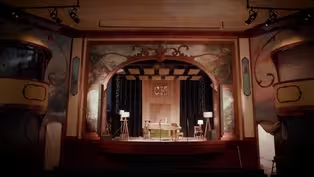
The overall design we did for the theater is in an almost Renaissance style.
It's been called Wallowa County Baroque.
-I'm going to frame this.
-Are you?
-I am.
-[ laughs ] Steve also introduced Darrell to a college graduate with a degree in painting named Anna Vogel.
STEVE: Anna Vogel, who I'd met and seen a small painting she'd done and thought, "She's good.
Let's bring her in on this."
All the paintings inside of the theater and around the proscenium are mine, after I moved here and became so inspired by the landscape.
One side is a lake view, and it shows the mountains over Wallowa Lake.
And the other side is kind of a glorified prairie sunset like you might see on the Zumwalt.
The OK Theatre is definitely, I'd say, a collaborative art piece.
I like the idea of thinking about it as a place for artists to perform and to be a work of art.
I think it's important, because theaters originally, and especially of that period and a little earlier, were works of art.
[ playing softly, singing indistinctly ] ♪ Tell me, darlin' Will it last ♪ ♪ Tomorrow night ♪ I wish there were more places like this.
This is a very difficult business to be in, and, you know, nowadays, the reality is that the musicians, we're competing with large television screens and Netflix.
[ laughs ] But inside the OK Theatre, time goes back to a place where the screen is a baroque proscenium and people gather for the thrill of live music.
Enjoy the show!
DARRELL: We've had a lot of shows where folks from Tri-Cities and Moscow and even Portland, they see something coming to the OK and think, "I want to see a show there."
So they come and sometimes spend a week here.
Now imagine you're walking down the street in New Orleans and you get to see this wonderful musician playing.
Turns out it's Jon Cleary.
[ all cheering ] ♪ Everything will be Just fine ♪ ♪ They'll tend to their business Whoa, and I'll tend to mine ♪ ♪ Everything will be just fine ♪ ♪ They're gonna tend To their business ♪ ♪ Yeah, I tend to mine ♪ ♪ Everything will be just fine ♪ [ audience cheering ] JON: My brain is like a jukebox on random select.
It's almost like there's a little man in my head going through a list of songs.
"What would be a good one to follow this?"
Sometimes it's the perfect occasion to go down and bring everybody with you and you can get very quiet.
♪ Flew in on the red-eye Put a quarter in the phone ♪ ♪ Forced to leave a message 'Cause there ain't nobody home ♪ ♪ I'm in a hotel Wonderin' where she's at ♪ ♪ You know, little girl Givin' me the third degree ♪ ♪ That ain't where it's at ♪ ♪ Saying when you get back We gon' talk all night long ♪ ♪ But she lied... ♪ Or you might be right in the moment just to completely go for it and get wild.
♪ When I loved you Honey, you sure don't love me ♪ ♪ Down here by the poor boys boastin'... ♪ ♪ Hurt my heart You tore that sucker in two ♪ The show was really cool.
It was rad.
Best music I've ever heard.
It definitely inspired me to go and start practicing an instrument of my own.
I think what Darrell and his family have done with the OK Theatre and turning it into a music venue and bringing artists that we could never get here into our community has been such a benefit to literally everyone.
DARRELL: We just feel so privileged to have people taking a bet on us and our judgment.
There's sort of a curation that goes on with this, where I'm like, "You are going to like it, I guarantee it."
[ audience whistling, cheering loudly ] [ ♪♪♪ ] When I Vogue, I feel like I am saying something.
I'm telling you how I'm feeling.
Sometimes I'm feeling flirty, and that really showcases maybe with, like, the way I'm looking at you.
[ music playing and crowd members exclaiming ] [ crowd members cheering ] It's the only dance style where I feel like I can actually say something.
So that's good.
[ crowd cheering ] SLADE: Daniel Giron has been a professional dancer in Portland since 2008.
He regularly wins dance competitions up and down the West Coast.
Daniel's specialty is the dance known as Vogue.
Voguing, it is a club style.
It's part of the drag ball scene that started in the 1960s.
The style of Vogue was inspired by Vogue magazine.
[ Madonna's "Vogue" playing ] You'll see that a lot of the poses are just very still.
It was popularized by Madonna's "Vogue" music video.
♪ Strike a pose ♪ Which actually showcases the Old Way style, like you are coming straight out of a magazine.
Whoo, so the hands were maybe a little two-dimensional.
♪ Vogue, Vogue ♪ Very elegant, very rich.
It's about giving you the picture.
It's about giving you the presentation.
What I do is Vogue Fem, which comes from the Latinx and black trans community.
And they broke down the hips and the wrist and added the hair and the attitude, because they felt like they couldn't really identify with the Old Way style.
Vogue Fem hands are very different.
They're very flow-y.
You got figure eights, you got taps, you got circles, yeah.
And you're just very playful overall with their movement.
Vogue Fem.
All right, if you're here for Vogue Fem, please make a circle in the center of the room for me.
I wanted to teach because I had seen a lot of enthusiastic vogue dancers.
Yeah, spread out if you need more space.
Go ahead and spread out.
I really started noticing how many people were doing it incorrectly.
I've been a preschool teacher for the last 10 years, so I do have really good qualities as far as, like, patience and, like, breaking things down.
You're gonna go single, single...
Single, single, double pump.
It's one thing to go over, you know, how to do hands and how to have all this body mechanics, but if you don't feel it here, if there's no character development, then there's nothing.
Five, six... Go!
[ rhythmic dance music playing ] I don't know why, but the catwalks across the floor in class really bring it out of people.
I turn up the music really loud, like louder than I'm supposed to, because I know that's gonna get it out of them.
Yes!
Six!
Being in this class is like gay church a little bit.
It's a place where, as a queer person of color, I'm able to thrive and feel celebrated, and that's really cathartic.
Lower, lower!
Let's go!
Five, six... MAN: The thing about this dance that I love is just feeling free.
I feel like my best self ever.
Like, no one can tell me anything and I rule the world, really.
That's how I feel.
Five, six, five, six... DANIEL: It's loud.
It's a party.
It's a culture.
You have to feel it.
So let's let it out.
This is group one.
[ ♪♪♪ ] I'm originally from Veracruz, Mexico.
I've always considered myself a natural mover, but I officially started dancing at the age of 19.
I moved to the United States at age 11 with my parents and my two older sisters.
We moved to Wilsonville, Oregon.
During high school, I was not dancing much, but there was a show on MTV called America's Best Dance Crew.
And where are we from?
ALL: New York City!
And what do we do?
ALL: Vogue!
From this show, I discovered Vogue.
Seeing it for the first time was surreal.
I always knew the moment I saw it that someday I would be doing it.
[ dance music playing and crowd cheering ] When I enter these open-style battles, I am able to showcase not just my Vogue but my Waacking and other dance styles that I've trained in.
A little bit of House, a little bit of Dance Hall.
I just get to fully by myself.
[ crowd cheering and DJ exclaiming ] The House of Ada is my house.
I established that in February 14, 2014.
You basically want to think of a house similar to how in breakdancing scene, they call themselves crews.
We're a collective of queer individuals who are artists and who learn from each other and partake in the ballroom scene.
[ crowd cheering, applauding ] DJ: Yes!
DANIEL: Being able to carve out a safe space where we can just dance and be happy and celebrate by expressing ourselves is a really beautiful thing.
I'm very proud to say that I have the first Vogue class in Portland.
It's really important for me as an instructor to just create a safe space for everybody.
There's really no reason for us to hold back on being us, and I think that's the beauty of what my class is bringing.
Yes!
Five, six.
Five, six, seven... To see more stories about Oregon artists, visit our website... And for a look at the stories we're working on right now, follow us on Facebook and Instagram.
[ ♪♪♪ ] Support for Oregon Art Beat is provided by... and OPB members and viewers like you.
Funding for arts and culture coverage is provided by...
Video has Closed Captions
Clip: S25 Ep4 | 11m 30s | A couple is restoring the OK Theatre, a century-old performing arts venue in rural Oregon. (11m 30s)
Video has Closed Captions
Clip: S25 Ep4 | 9m 34s | Visit a secret warehouse in NW Portland with nearly 20,000 pieces of art. (9m 34s)
Providing Support for PBS.org
Learn Moreabout PBS online sponsorship










Support for PBS provided by:
Oregon Art Beat is a local public television program presented by OPB