
Hearing: How Your Ears Work
Special | 4m 30sVideo has Closed Captions
How do your ears work?
Hearing is one of your five senses. Learn how sound travels through your auditory system so your brain can hear what’s going on. And that’s not all your ears do. Your ears play a vital part in keeping your balance and figuring out where you are in the world. Find out how your ears work.
Problems playing video? | Closed Captioning Feedback
Problems playing video? | Closed Captioning Feedback
Science Trek is a local public television program presented by IdahoPTV
Major Funding by the Laura Moore Cunningham Foundation and the Idaho National Laboratory. Additional Funding by 360 Immersive, the Friends of Idaho Public Television and the Corporation for Public Broadcasting.
Hearing: How Your Ears Work
Special | 4m 30sVideo has Closed Captions
Hearing is one of your five senses. Learn how sound travels through your auditory system so your brain can hear what’s going on. And that’s not all your ears do. Your ears play a vital part in keeping your balance and figuring out where you are in the world. Find out how your ears work.
Problems playing video? | Closed Captioning Feedback
How to Watch Science Trek
Science Trek is available to stream on pbs.org and the free PBS App, available on iPhone, Apple TV, Android TV, Android smartphones, Amazon Fire TV, Amazon Fire Tablet, Roku, Samsung Smart TV, and Vizio.
Science Trek
Science Trek is a place where parents, kids, and educators can watch short, educational videos on a variety of science topics. Every Monday Science Trek releases a new video that introduces children to math, science, technology, engineering, and math (STEM) career potentials in a fun, informative way.More from This Collection
The human body is an amazing thing. It is made up of various systems that work together to keep us breathing, eating, thinking, growing and playing. Find out more about everything from the brain in your head to the bones in your feet.

Five Senses: It's All in Your Head
Video has Closed Captions
You understand the world through your brain. (6m 38s)
Blood: Your Body's Report Card
Video has Closed Captions
Learn about the role medical professional have in caring for your blood. (5m 40s)

Digestive System: Go Inside The Digestive System
Video has Closed Captions
What goes on inside your digestive system? (7m 7s)

Digestive System: Cow Stomach Investigation
Video has Closed Captions
How is a cow’s stomach different from a human’s? (6m 40s)
Video has Closed Captions
Learn how your skin helps maintain your health and keeps you in touch with the world. (4m 53s)
Skeletons: Skeletons Uncovered
Video has Closed Captions
Your skeleton is more than a collection of bones. Find out how your skeletal system works. (4m 3s)
Skeletons: Just How Do They Know It’s A Dinosaur?
Video has Closed Captions
Paleontologists study skeletons to learn about ancient species. (6m 12s)
Video has Closed Captions
Viruses play a big role in disease. But how? (6m 33s)
Providing Support for PBS.org
Learn Moreabout PBS online sponsorshipJoan Cartan-Hansen, Host: Hearing is one of your five senses.
It's called the auditory system and it does more than just take in sound.
So listen up.
(Music) Student one: Would you like a drink of water?
Student two: What?
Student one: (louder) Would you like a drink of water?
Student two: What?
Student one: You can't hear me if your music's too loud and besides, that's bad for your hearing.
Student two: Why?
Student one: Because loud sounds can damage your ears.
Student two: How?
How does your hearing work?
Cartan-Hansen: Hearing begins with sound.
When you make a sound, you create energy in the form of sound waves.
A loud sound (loud thud) has taller waves than a (page turn) soft one.
Those sound waves eventually enter your ears.
The sound travels down the ear canal.
The ear canal is about an inch long and at its end is a thin piece of skin called the eardrum.
The eardrum is stretched tight, just like the top of a drum.
When soundwaves hit the eardrum, it begins to vibrate.
That vibration makes three tiny bones in your middle ear begin to move.
These three tiny bones are known as the hammer, anvil and stirrup because that is kind of what they look like.
These three bones transmit or move the sound along to the inner ear.
They also increase the force of the soundwaves.
Soundwaves then move into a snail-shaped structured in the inner ear called the cochlea.
The cochlea is filled with fluid and more than 17 thousand tiny hair-like tissues called hair cells.
Soundwaves move through the fluid and the hairs cells bend.
The movement of those hair cells stimulates the 30 thousand nerve fibers leading to the hearing nerve.
That nerve carries the signal to the brain.
And the brain figures out what the sound is.
It's important to protect your hearing from loud sounds.
Muscles in the middle ear protect the ear by stiffening the ear drum and the movement of the hammer, anvil and stirrup bones.
But sudden loud sounds can break and damage the hair cells in the cochlea and can even break the eardrum.
And continued loud sounds can also damage those tiny hair cells.
So be sure to wear hearing protection like earmuffs or ear plugs if you are going to be around loud sounds and turn the volume down on your headphones.
Because once your hearing is damaged, it can't be made all better.
About two hundred thousand Americans are deaf.
That means they can't hear anything.
Another three million have severe hearing problems.
They use hearing aids to amplify or increase the strength of sound waves so they can hear better.
Others have a cochlea implant.
That's where a small microphone helps transmit sound to the hearing nerve.
Individuals who are deaf or hard-of-hearing sometimes use sign language to communicate.
Others can read lips.
Communicating, whether it is with your ears or your hands is essential to life.
And you need two ears to figure out where a sound is coming from.
Your brain figures out the difference between the two sound levels in each ear and calculates where the sound is coming from.
Oh, by the way, your ears do something else.
Another part of the inner ear is called the vestibular system.
Movement of the fluid inside the vestibular system tells your brain about your body position and the direction that you are moving in.
That way you can tell up from down, even with your eyes closed.
And when you spin around, the fluid in the vestibular system spins too.
That fluid keeps moving for a bit even after you've stopped and that explains why you feel dizzy.
Student two: Wow, I didn't know our auditory system was so important.
I'll pay more attention to my hearing.
Oh, I'll have that water now.
Student one: Oh sorry, I didn't hear you.
Cartan-Hansen: If you want to learn more about hearing, check out the science trek website.
You'll find it at idahoptv.org/sciencetrek.
(Music) Announcer: Presentation of Science Trek on Idaho Public Television is made possible through the generous support of the Laura Moore Cunningham Foundation, committed to fulfilling the Moore and Bettis Family legacy of building the great state of Idaho; by the Idaho National Laboratory, mentoring talent and finding solutions for energy and security challenges; by the Friends of Idaho Public Television; and by the Corporation for Public Broadcasting.

Hearing: The Ears are Where!?!
Video has Closed Captions
Clip: Special | 1m 4s | Which hears better…cats or dogs? (1m 4s)

Hearing: What Can Humans Hear?
Video has Closed Captions
Clip: Special | 1m 4s | How is sound measured? (1m 4s)
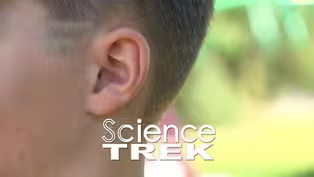
Hearing: What is that flap of skin?
Video has Closed Captions
Clip: Special | 1m 4s | What do you call that flap of skin on the sides of your head? (1m 4s)
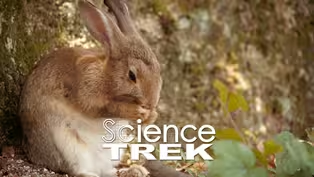
Hearing: Which Animal Hears Best
Video has Closed Captions
Clip: Special | 1m 4s | Find out which animals have better hearing than humans. (1m 4s)
Providing Support for PBS.org
Learn Moreabout PBS online sponsorship
- Science and Nature

Explore scientific discoveries on television's most acclaimed science documentary series.

- Science and Nature

Capturing the splendor of the natural world, from the African plains to the Antarctic ice.












Support for PBS provided by:
Science Trek is a local public television program presented by IdahoPTV
Major Funding by the Laura Moore Cunningham Foundation and the Idaho National Laboratory. Additional Funding by 360 Immersive, the Friends of Idaho Public Television and the Corporation for Public Broadcasting.