
Hearing: The Ears are Where!?!
Clip: Special | 1m 4sVideo has Closed Captions
Which hears better…cats or dogs?
Humans use six ear muscles to catch sound, but dogs and cats have many more. They can hear better than humans. Some animals don’t have ears like us. Find out more about how animals “hear.”
Problems playing video? | Closed Captioning Feedback
Problems playing video? | Closed Captioning Feedback
Science Trek is a local public television program presented by IdahoPTV
Major Funding by the Laura Moore Cunningham Foundation and Idaho National Laboratory. Additional Funding by 360 Immersive, the Friends of Idaho Public Television and the Corporation for Public Broadcasting.
Hearing: The Ears are Where!?!
Clip: Special | 1m 4sVideo has Closed Captions
Humans use six ear muscles to catch sound, but dogs and cats have many more. They can hear better than humans. Some animals don’t have ears like us. Find out more about how animals “hear.”
Problems playing video? | Closed Captioning Feedback
How to Watch Science Trek
Science Trek is available to stream on pbs.org and the free PBS App, available on iPhone, Apple TV, Android TV, Android smartphones, Amazon Fire TV, Amazon Fire Tablet, Roku, Samsung Smart TV, and Vizio.

Science Trek
Science Trek is a place where parents, kids, and educators can watch short, educational videos on a variety of science topics. Every Monday Science Trek releases a new video that introduces children to math, science, technology, engineering, and math (STEM) career potentials in a fun, informative way.(Music) Joan Cartan-Hansen, Host: How are dogs and cats ears different than humans?
Dog ears are controlled by up to 18 muscles, while human use only six.
All those muscles help dogs better find the location of a sound, hear it more clearly and from farther away.
A cat's hearing is even better than a dogs.
Cats can hear a wider range of sounds and have 30 ear muscles especially designed to help them figure out what different sounds are.
Birds don't have external ears, just openings.
Their heads are shaped to direct sound into their inner ears.
Snakes don't have ears like us at all.
They feel vibrations and that's how they detect sound.
Some fish also detect sound through vibrations but their ears are on the inside.
Bony fish detect vibrations through their earstones called otoliths, but both fish and mammals use their ears to help with balance.
So that's something we have in common.
For more information about hearing, check out the science trek website.
You'll find it at idahoptv.org/science trek

Hearing: What Can Humans Hear?
Video has Closed Captions
Clip: Special | 1m 4s | How is sound measured? (1m 4s)
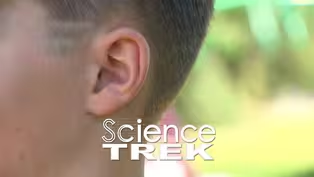
Hearing: What is that flap of skin?
Video has Closed Captions
Clip: Special | 1m 4s | What do you call that flap of skin on the sides of your head? (1m 4s)

Hearing: Which Animal Hears Best
Video has Closed Captions
Clip: Special | 1m 4s | Find out which animals have better hearing than humans. (1m 4s)
Providing Support for PBS.org
Learn Moreabout PBS online sponsorship
- Science and Nature

Explore scientific discoveries on television's most acclaimed science documentary series.

- Science and Nature

Capturing the splendor of the natural world, from the African plains to the Antarctic ice.












Support for PBS provided by:
Science Trek is a local public television program presented by IdahoPTV
Major Funding by the Laura Moore Cunningham Foundation and Idaho National Laboratory. Additional Funding by 360 Immersive, the Friends of Idaho Public Television and the Corporation for Public Broadcasting.