
Trump's rationale and objectives for Iran war remain unclear
Clip: 3/6/2026 | 13m 9sVideo has Closed Captions
Trump's rationale and objectives for Iran war remain unclear
It was just last week that President Trump launched a war against Iran after telling Americans that he was opposed to new wars, especially new Middle East wars. The Iranian regime is practically leaderless and on its back foot, but the commander-in-chief of American forces has yet to explain to a doubting public the rationale for the war.
Problems playing video? | Closed Captioning Feedback
Problems playing video? | Closed Captioning Feedback
Major funding for “Washington Week with The Atlantic” is provided by Consumer Cellular, Otsuka, Kaiser Permanente, the Yuen Foundation, and the Corporation for Public Broadcasting.
Trump's rationale and objectives for Iran war remain unclear
Clip: 3/6/2026 | 13m 9sVideo has Closed Captions
It was just last week that President Trump launched a war against Iran after telling Americans that he was opposed to new wars, especially new Middle East wars. The Iranian regime is practically leaderless and on its back foot, but the commander-in-chief of American forces has yet to explain to a doubting public the rationale for the war.
Problems playing video? | Closed Captioning Feedback
How to Watch Washington Week with The Atlantic
Washington Week with The Atlantic is available to stream on pbs.org and the free PBS App, available on iPhone, Apple TV, Android TV, Android smartphones, Amazon Fire TV, Amazon Fire Tablet, Roku, Samsung Smart TV, and Vizio.
Buy Now
10 big stories Washington Week covered
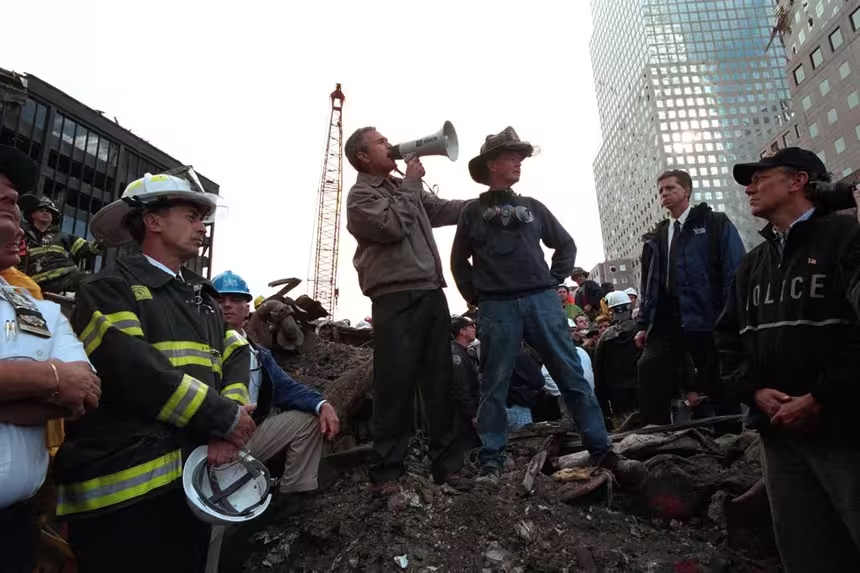
Washington Week came on the air February 23, 1967. In the 50 years that followed, we covered a lot of history-making events. Read up on 10 of the biggest stories Washington Week covered in its first 50 years.Providing Support for PBS.org
Learn Moreabout PBS online sponsorshipIt was just last week that President Trump launched a war against Iran after telling Americans that he was opposed to new wars, especially new Middle East wars.
Thanks to the US Navy and the US and Israeli air forces, the Iranian regime is practically leaderless and on its back foot, but the commander in chief of American forces has yet to explain to a doubting public the rationale for the war.
To discuss where we are, I'm joined tonight by Peter Baker, the chief White House correspondent at The New York Times.
Susan Glasser is a staff writer at The New Yorker.
Kariem Sadjadpour is a contributing writer at The Atlantic and a senior fellow at the Carnegie Endowment for International Peace, and Nancy Yousef is a staff writer and a Pentagon correspondent at The Atlantic.
Thank you all for, for joining me.
It's only been a week.
Feels like a year.
Uh, Peter, why did Donald Trump go to war against Iran?
It's a very good question.
Thank you very much.
And it only has about 6 or 8 answers depending on which one you want to pick at any given time.
What if you had to explain in 10 seconds, why did we go to war now?
it's a very good question, and the truth is we don't know the answer, right?
They have given us multiple versions of that story all week.
He went for it now because he had a feeling according to his press secretary that something bad might happen that Iran was going to attack.
He went to war because the Israelis were going to go to war anyway and therefore they decided they had to go with the Israelis, otherwise there would be retaliation against American forces.
That was Marco Rubio.
The president said that they needed to go after the nuclear program, which of course he had already told us was obliterated, and we had to go out for the ballistic missile program, which intelligence tells us is not yet the threat that he said it was.
So why now is still an open question.
I think a lot of reasons are he felt emboldened by Venezuela and he's becoming increasingly comfortable with power as he goes further into his second term.
Susan, Venezuela without success in Venezuela, this wouldn't happen.
Well, I mean, Donald Trump told The New York Times that he's given about 80 million quick phone interviews this week.
In one of them, and multiple of them, he called Venezuela the perfect scenario for what he now has in mind in Iran, and I think that's really notable because he began this conflict overnight last Friday night, saying that actually regime change was more or less the goal of the US operation within a couple of days you saw his top officials saying no, no actually it's not about regime change.
Trump sometimes says it is, sometimes says it isn't, but his version, Jeff, of regime changed looks something like Venezuela, I think, which is basically abandoning the Democratic opposition in Venezuela, which the United States has supported and saying, well, we're going to take out Nicolas Maduro but leave his entire apparatus of repression of his own country intact and go with his vice president, right, Nancy, Venezuela and Iran obviously very different countries Iran is a much more complicated military and strategic target.
Fair, fair.
Thank you.
Go on.
Well, look, um, Iran is bigger than Venezuela and Afghanistan combined.
Iran has ballistic missile capability, has a sophisticated drone capability.
It has the ability to pose a threat to every ally and partner in the region, and it is off the Strait of Hormuz, which is where 1/5 of the oil transiting through the um waters goes, which means that it poses a threat to world global economic markets as well, and so it's ability to present economic threats to present security threats to the Gulf regions to present security threats to Israel and the complexity of its defenses means that it could potentially pose a threat for a sustained period of time, that while the president talks about this spino campaign that last week's, the 2nd and 3rd order effects could reverberate throughout the region.
Kareem, I want to read you, um, something that Trump posted today.
He wrote on Truth Social, uh, there will be no deal with Iran except unconditional surrender, all capital letters.
After that, in the selection of a great and acceptable leader or leaders.
We and many of our wonderful and very brave allies and partners will work tirelessly to bring Iran back from the brink of destruction, making it economically bigger, better, and stronger than ever before.
Iran will have a great future, make Iran great again.
mega, parentheses, quote, Thank you for your attention to this matter.
Um, so Kareem, it was, um, there's, there's, there's, there's confusion about this.
It was either Trotsky or Rosa Luxembourg or possibly Peter Baker for all I know, who said before a revolution happens it is perceived as impossible after it happens, it is seen as having been inevitable.
This will be the last time I quote Trotsky on this show, by the way, just noting for the record.
Um, what are the chances that Trump gets his successful revolution.
something that we can't necessarily picture at this moment.
So that quote is also attributed to Hannah Arend.
So yes, many potential authors of it.
So this in my view is a very high risk, high reward gambit from the president and I use the word gambit deliberately.
This is a big gamble.
Iran is a country which is ruled by one of our worst adversaries, the Islamic Republic that came to power in 1979.
My view is there's probably no country on earth with a greater gap between its rulers and its citizens than Iran.
You have a government that acts like North Korea, a society that wants to be like South Korea.
So if you're able to to change the leaders in Iran and empower the people into some kind of a representative government or at a minimum a government which represents its own national interests rather than this revolutionary ideology of 1979, that would be a geopolitical game changer for the United States and huge victory for President Trump, and I I do think, you know, he's posted this as well that he aspires to visit Caracas, Havana, and Tehran before his presidency is over.
Big goals.
What are the, what are the chances that something as clean, I use that in, you know, in quotes, but something as clean as what happened in Venezuela happens in Iran that somehow there's a leader or somebody near the top who actually doesn't believe that America is the great Satan and wants to have a relationship with the United States.
What are the chances of that happening without full scale civil war at the moment it looks unlikely, you know, Delci Rodriguez, the #2 to Maduro, was a very powerful person in the Venezuelan system.
And when we assassinated Ayatollah Khamenei, that was kind of the political equivalent of a bunker buster.
He was Iran's longest serving dictator, perhaps one of the world's longest serving dictators, 37 years, he had been in power and so that left a vacuum which no one can quickly fill.
And at the moment I would argue there's no single Iranian official who has the legitimacy, the authority, or even the will to break with 47 years of ideology.
Stay on this for one more moment.
You're one of the world's leading experts on Iranian leadership, among other things.
How manye's son?
has the possible credibility to do this?
What do we know about him and the way he sees the world.
So K Khamenei's son, his name is Mojtaba.
He's a 56-year-old cleric, and his long been his father's right hand, and he's kind of a la liaison between the senior clergy and the revolutionary Guards.
Now there's a body called the Assembly of Experts.
It's 88 clerics.
My joke about them, their average age is deceased, part of old men, they don't have to retire like the College of Cardinals.
They just go on, yeah, and so in theory, they're the ones that are supposed to anoint the next Supreme Leader.
I spoke to a source in Tehran who told me that because his father was assassinated, his wife was also killed, and his mother was also killed.
Mostaba Khamenei's stock rose after that, but Jeff, my view is if he indeed is anointed as Supreme Leader.
His father ruled for 37 years.
He may not be alive for 37 days because there will be an Israeli bull's eye on his back, right?
Would he, is there any indication of his thinking?
Does he have any thinking that's different than his father.
Look, his father, like his predecessor, the founder of the leader of the revolution, the originator of the revolution, Khomeni.
believed in, in, in basically three pillars, as you have written in The Atlantic and elsewhere, the hijab, Death to America, death to Israel.
Is there anybody in that system who is a reformer?
Let's say a Gorbachev type of figure who buys some of the some of the ideology, but in a softer way.
So Moabba Khamani, I would say is a 10 out of 10 ideologue.
There are some folks I would describe as 8 out of 10 ideologues.
One of the guys who's kind of administering the country now politically as a guy called Ali Rarijani.
He is a hard man.
He was, he oversaw the massacre last January.
He's not at all a Democrat, but he's one of the people who perhaps believes that to save the regime, to save the revolution, we may need to compromise and the model that someone like that has in mind is not Gorbachev, but China's Deng Xiaoping to start to prioritize economic national interests before revolutionary ideology, right?
So the for for people who are reporting on this this week, have, have you heard from the administration anything as cogent as what Kareem's just articulated, which is to say anybody inside the administration who says, look, here are the following 8 people who could run this country, and we're focused on this one, and we think maybe this will work.
Here's what you heard.
You heard the president of the United States get on the phone with my colleagues Oen kind of Youngs from the New York Times says we've got people who I'm looking at who might be the next leader, and the next journalist phone call he made is there were people we were looking at, but it turns out we killed them.
So this is the level of organization they have when it comes to thinking about what comes next in Iran.
There there was no plan There is no organization, and there's no thought given to how to actually create an atmosphere in which they could have different regime and and at one minute he says that people should rise up.
The next one, he says, no, we keep the same regime but with other people.
I think the confusion too for the American public is militarily the Pentagon says that the plan is going well, that they're able to weaken their ballistic missile capability that they're able to go after their nuclear.
These things are true and they're true, right?
And but those tactical successes don't lead to a strategic success.
So I think that's part of the confusion that the American people are suffering because how do you tie a weakened state to one that can have people rise up or be governed in its own way, and I, and, and there's never been any doubt that the military could do this.
They are, they have the resources to do these kinds of things.
They don't have the ability to change things on the ground by themselves.
Susan, our Atlanta colleague Tom Nichols makes this point frequently that there's a, there's a the the gap between American military capability, which is pretty extraordinary.
An Israeli alongside in this case and the level of strategic planning is, is, is so large as to be dangerous.
Talk about that a little bit when, when, when you have a military that can basically you push a button and it and it figures out a way to get something that seems impossible done.
Well, that's right.
I mean, look, the fantasy of the sort of the transformative event via air power with no American boots on the ground, you know, this has existed not just for the Trump presidency.
There's not a good record of outcomes that produce sort of small d democratic leaders and transformation.
When you do something like that, but I have to say listening to this conversation, all of us here covered the wars in Afghanistan and Iraq, and you know I was on the ground in southern Iraq on the day that Saddam's forces left the southern city of Basra, and you know you see these two things coexisting and remember the Bush people spent a lot more time both preparing the groundwork for this war and you know thinking about what would happen there, it turned out not enough, uh, but they had a theory.
They had a theory, but more importantly, we had no idea.
So within literally hours of uh Saddam's government leaving and the forces disappearing, you know, we had overwhelming military superiority.
It didn't take that much of a fight, and yet there's huge crowds in the streets.
There's huge political activity and the American and British officers we spoke with had no idea what they were doing there.
They didn't know what the goal was, and that was again, even before the insurgency in Iraq began.
When you see these clips playing over and over again right now of Donald Rumsfeld.
He's being asked right before the invasion of Iraq?
How long is it going to last?
And he says, Well, it could be 6 days, it could be 6 weeks.
It certainly won't be 6 months.
That's the clip that I ' ve seen circulating.
I mean, you know, Donald Trump says it's going to be 4 to 5 weeks.
 New
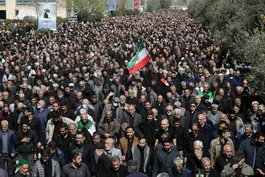
NewTrump demands Iran’s surrender, but ending war is not easy
Video has Closed Captions
Clip: 3/6/2026 | 8m 10s | Trump demands Iran’s surrender, but ending war is not easy (8m 10s)
Providing Support for PBS.org
Learn Moreabout PBS online sponsorship
- News and Public Affairs

Top journalists deliver compelling original analysis of the hour's headlines.

- News and Public Affairs

FRONTLINE is investigative journalism that questions, explains and changes our world.











Support for PBS provided by:
Major funding for “Washington Week with The Atlantic” is provided by Consumer Cellular, Otsuka, Kaiser Permanente, the Yuen Foundation, and the Corporation for Public Broadcasting.